
Dynamic AJAX Product Filters for WooCommerce includes SEO options that help make filtered product pages more search-engine friendly. These settings allow you to control filter URLs, permalink structure, indexable filter links, SEO title, SEO description, and SEO keywords for filtered product results.
SEO settings are useful when you want filtered product pages to be more readable, shareable, and optimized for search engines.
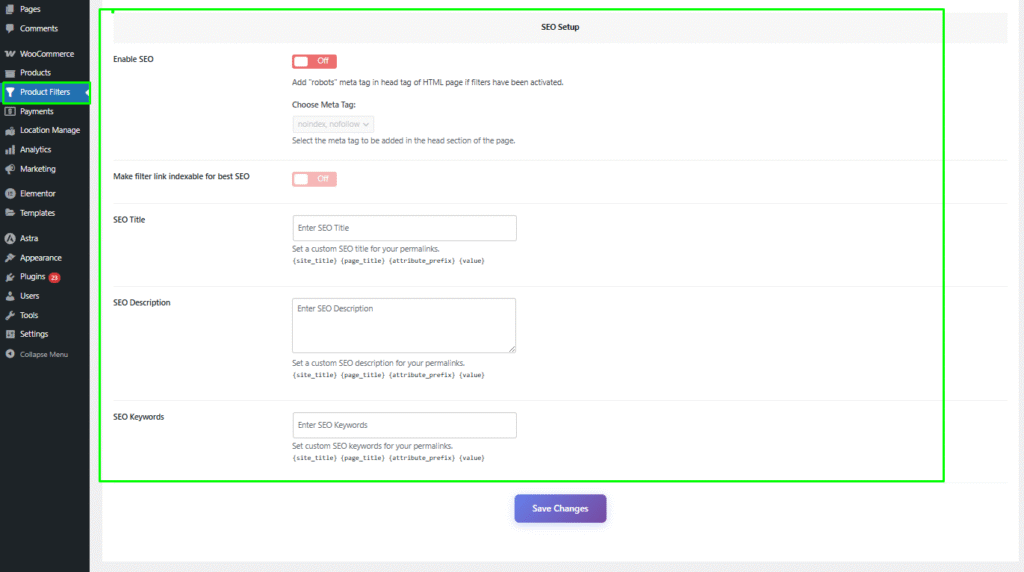
Where to Find SEO Settings
To configure SEO settings:
- Go to your WordPress Dashboard.
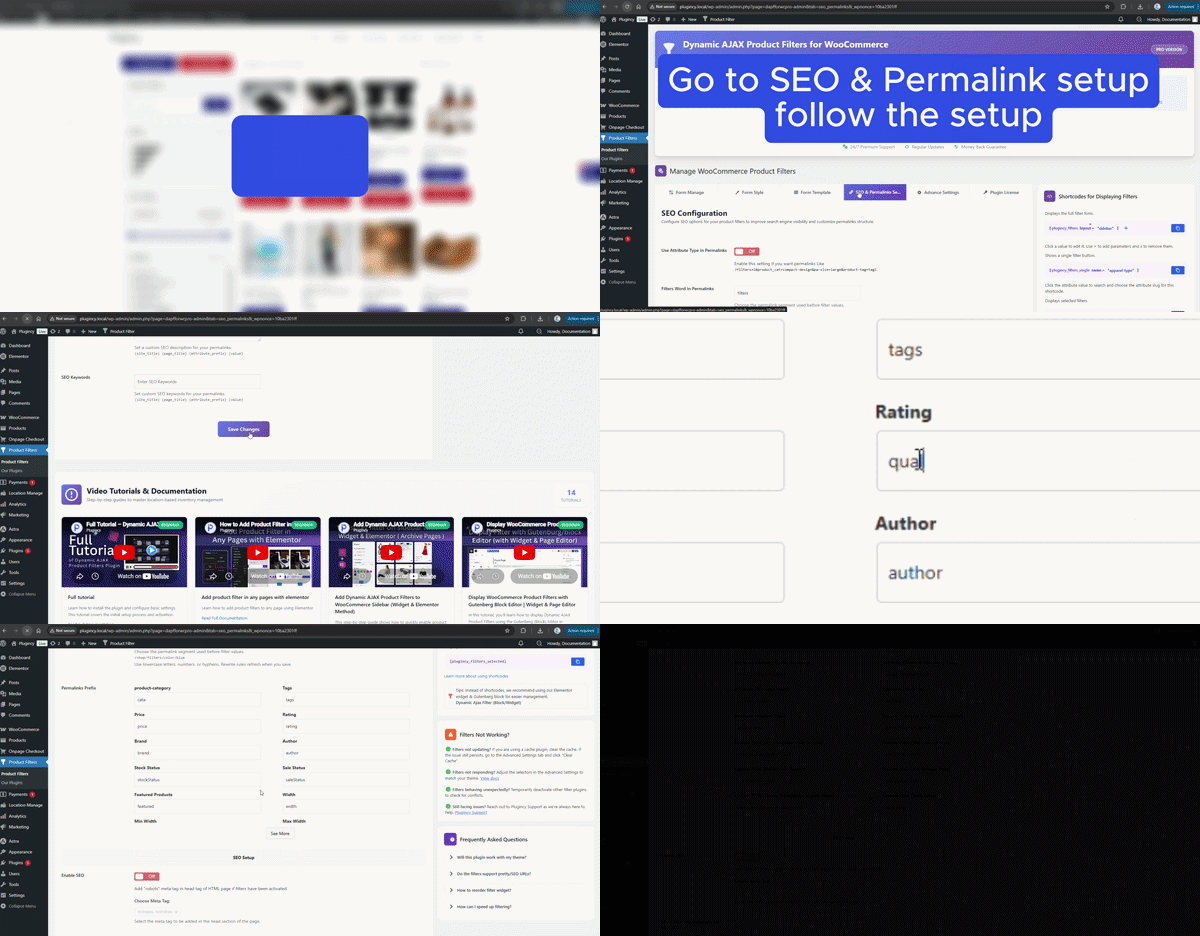
- Navigate to Product Filters → SEO.
- Configure the available SEO and permalink options.
- Click Save Changes.
Important Requirement
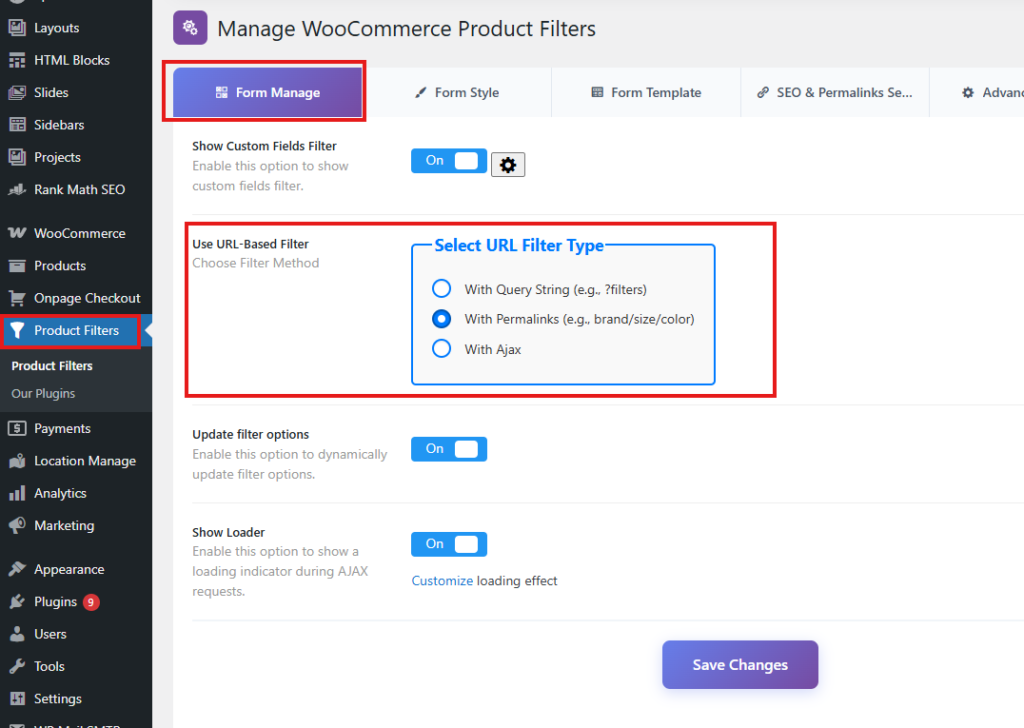
SEO permalink settings work when the filter method uses URL-based filtering.
If your filter method is set to AJAX only, some SEO and permalink options may not be available because AJAX-only filtering does not create fully crawlable filter URLs.
To access more SEO options, go to:
Product Filters → Form Manage → Use URL-Based Filter
Then choose a URL-supported filter method instead of pure AJAX mode.
Enable SEO
The Enable SEO option allows the plugin to generate SEO-related metadata for filtered product pages.
When enabled, the plugin can use your configured SEO title, description, and keywords for filtered product result pages.

This helps search engines better understand filtered product pages such as:
Shop filtered by category
Shop filtered by brand
Shop filtered by color
Shop filtered by price
Shop filtered by rating
Shop filtered by stock status
Make Filter Link Indexable for Best SEO
The Make filter link indexable for best SEO option helps generate crawlable filter links.
When enabled, filter options can be output as links instead of only JavaScript-based actions. This can help search engines discover filtered pages more easily.
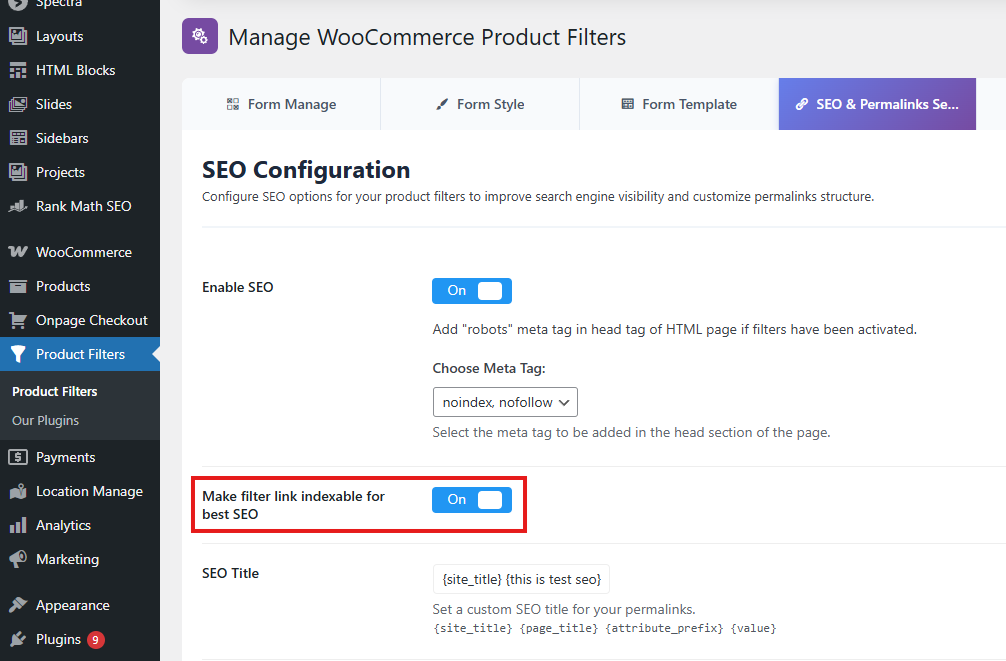
Use this option if you want search engines to crawl important filtered product combinations.
When Should You Use Indexable Filter Links?
Enable indexable filter links when filtered pages have real SEO value.
Good examples:
Men’s Shoes
Red Dresses
Nike Sneakers
Wooden Furniture
In Stock Products
Sale Products
Products Under $100
Avoid indexing too many low-value filter combinations, especially if your store has thousands of attributes or many overlapping filters.
SEO Title
The SEO Title field lets you customize the page title for filtered product pages.
A good SEO title should be clear, relevant, and include important product/filter terms.
Example:
Shop {filter_name} Products Online
Another example:
Buy {category} Products - Best Deals Online
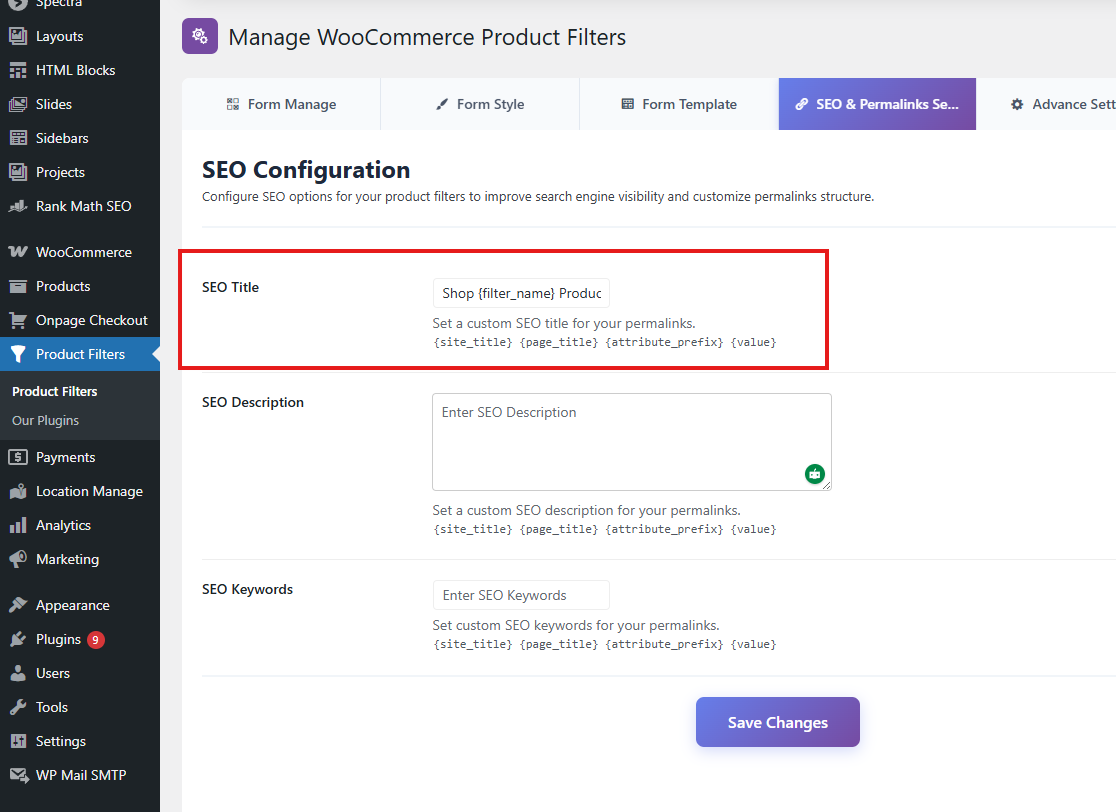
Use a title that describes the filtered product results accurately.
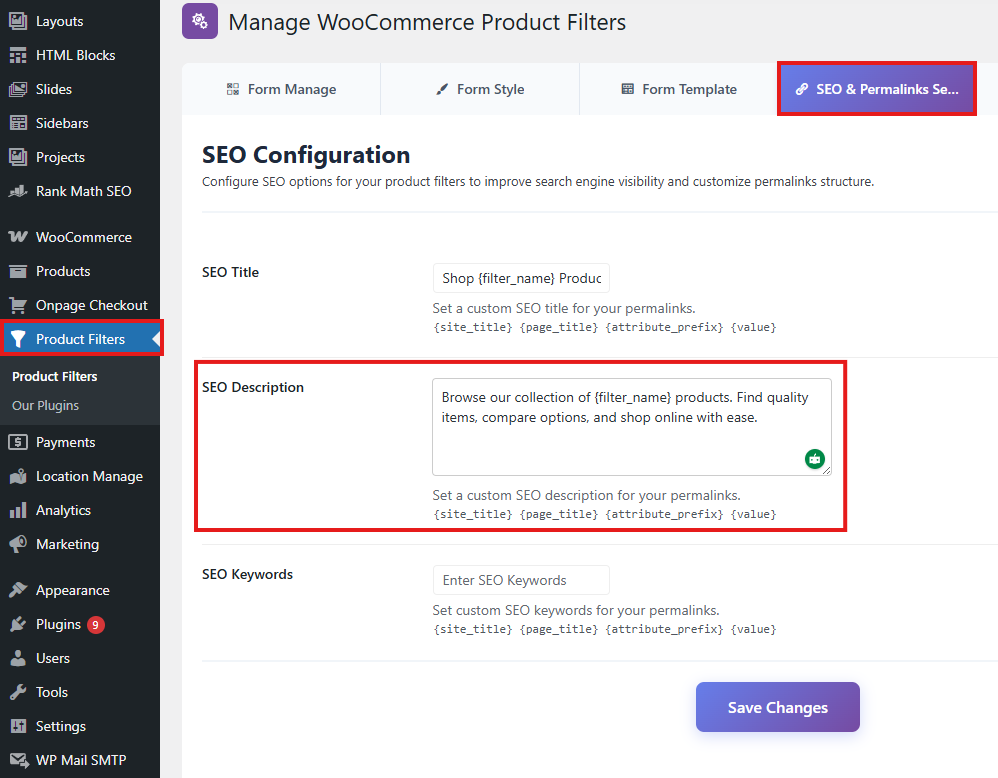
SEO Description
The SEO Description field lets you add a custom meta description for filtered product pages.
A good SEO description should briefly explain what customers can find on the filtered page.
Example:
Browse our collection of {filter_name} products. Find quality items, compare options, and shop online with ease.
Another example:
Discover the best {category} products available in our store. Filter by price, brand, rating, and availability.
Keep the description natural and helpful for customers.
SEO Keywords
The SEO Keywords field lets you define keywords related to filtered product pages.
Example:
woocommerce products, filtered products, shop by category, shop by brand
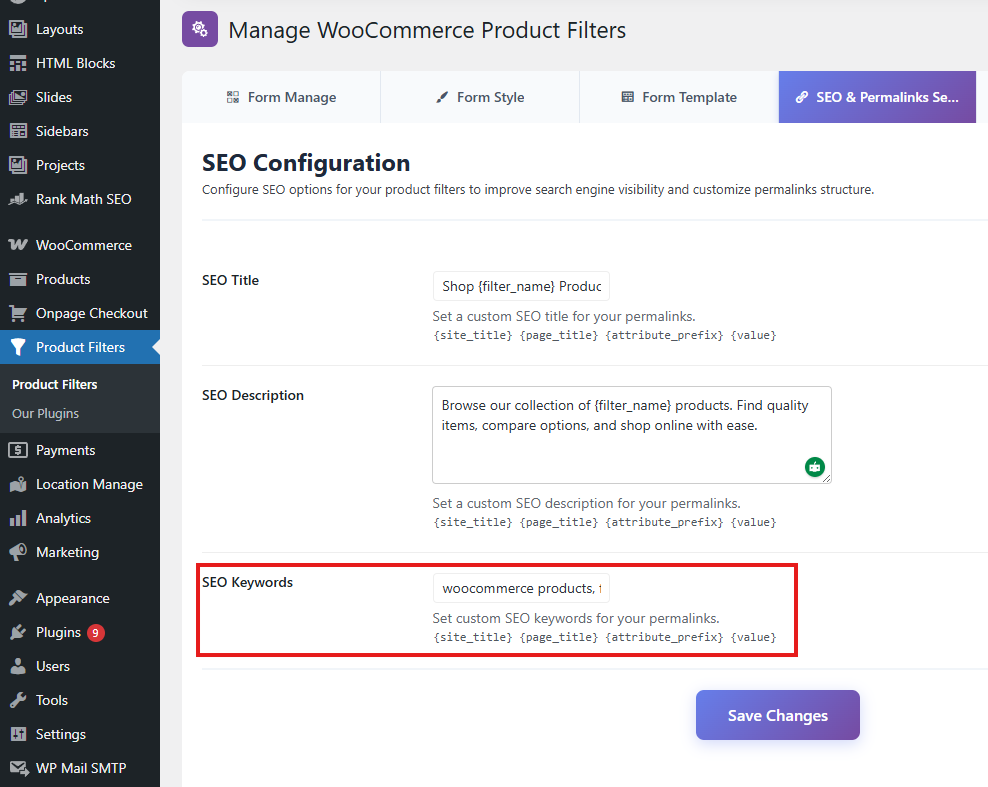
You can use keywords related to your store, product type, category, brand, or filter values.

SEO-Friendly Permalinks
The plugin allows you to configure filter URL structures so filtered pages can have readable and SEO-friendly URLs.
Instead of a long or unclear URL, SEO-friendly filter URLs can make selected filters easier to understand.
Example structure:
example.com/shop/filters/cata/shoes/color/red/
A readable URL is better for customers and easier to share.
Use Attribute Type in Permalinks
The Use Attribute Type in Permalinks option controls whether the filter type is included in the URL structure.
When enabled, the URL can include the filter group/type before the selected filter value.
Example:
color/red
size/large
brand/nike
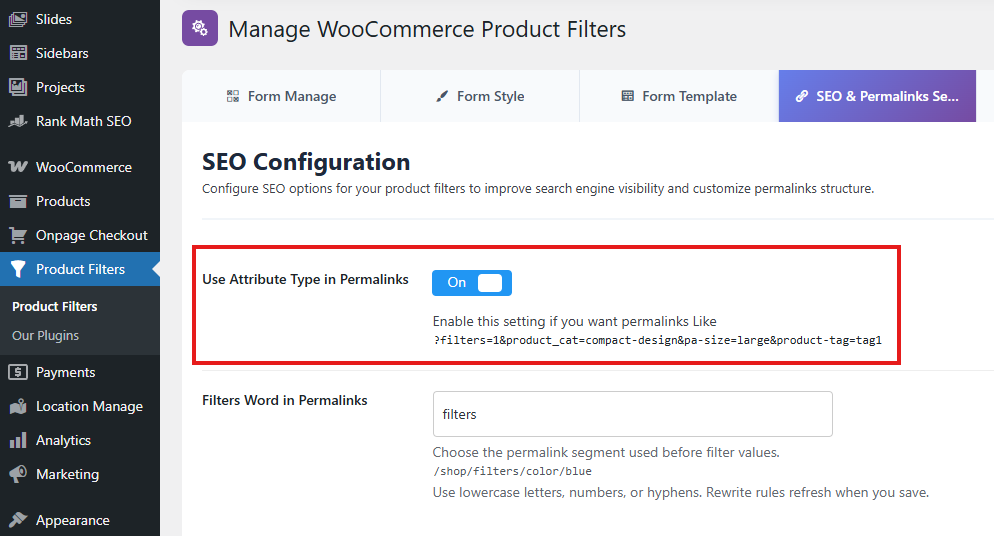
This makes the permalink more descriptive and organized.
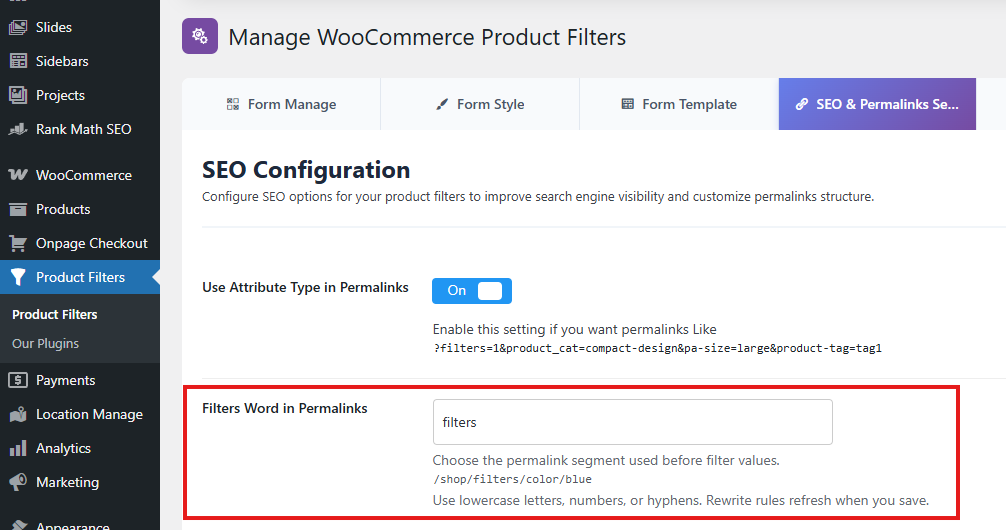
Filters Word in Permalinks
The Filters Word in Permalinks option lets you define the base word used in filter URLs.
Default value:
filters
Example URL:
example.com/shop/filters/color/red/
You can change this word if you want a different URL structure.
Example:
filter
or:
shop-by
Result example:
example.com/shop/shop-by/color/red/

Permalinks Prefix
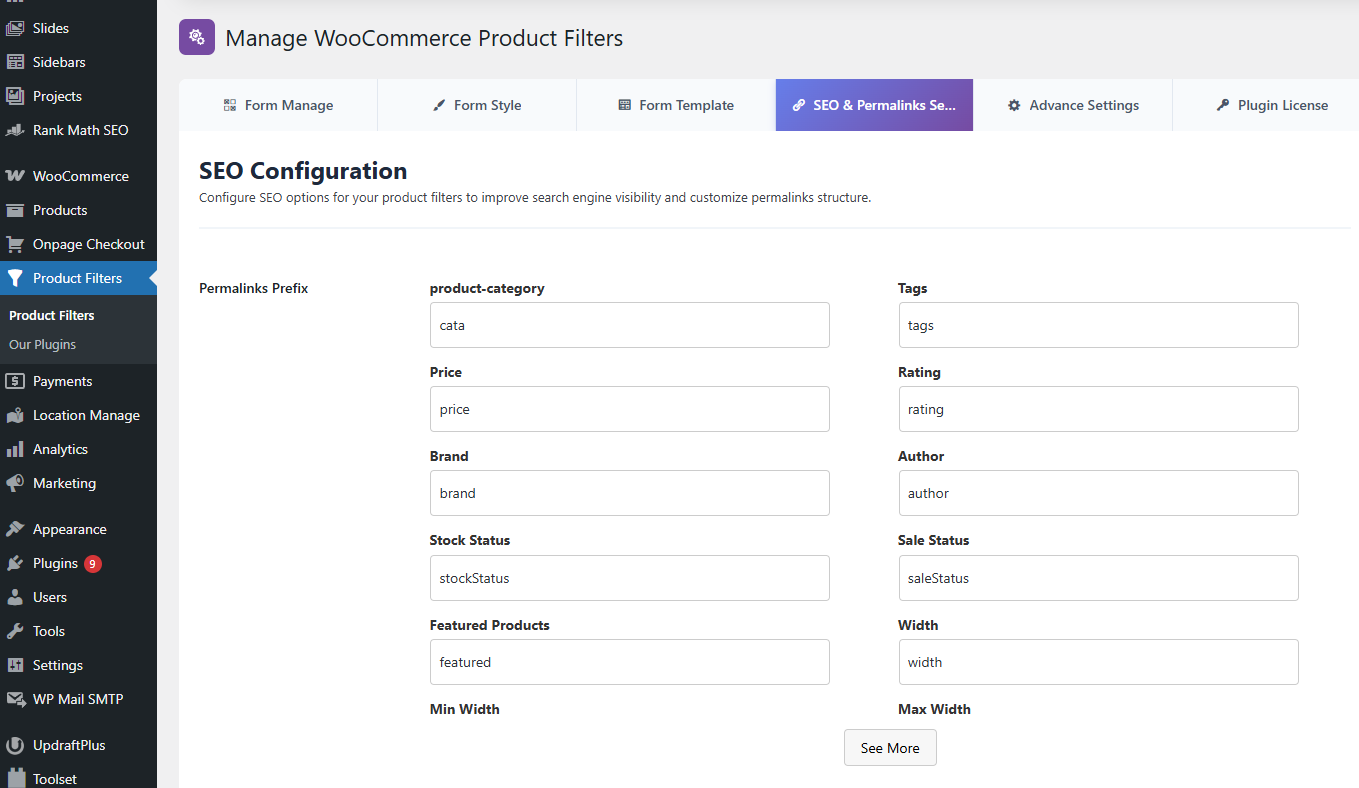
The Permalinks Prefix section allows you to customize the URL prefix used for different filter types.
This gives you control over how each filter appears in the URL.
Common prefix examples:
| Filter Type | Example Prefix |
|---|---|
| Product Category | cata |
| Product Tag | tags |
| Attribute | Attribute slug, such as color or size |
| Price | price |
| Rating | rating |
| Brand | brand |
| Author | author |
| Stock Status | stockStatus |
| Sale Status | saleStatus |
| Featured Products | featured |
| SKU | sku |
| Discount | discount |
| Date Filter | date |
| Search | title |
| Pagination | paged |
Example SEO Permalink Setup
Example settings:
Filters Word in Permalinks: filters
Category Prefix: cata
Tag Prefix: tags
Brand Prefix: brand
Price Prefix: price
Rating Prefix: rating
Search Prefix: title
Example filtered URL:
example.com/shop/filters/cata/shoes/brand/nike/price/50-150/
This URL clearly shows that the customer is viewing shoes filtered by Nike and price range.
Recommended SEO Settings
For most WooCommerce stores:
Enable SEO: Enabled
Make filter link indexable: Enabled only for important filters
Use Attribute Type in Permalinks: Enabled
Filters Word in Permalinks: filters
For stores with many filters:
Enable SEO: Enabled
Make filter link indexable: Use carefully
Use Attribute Type in Permalinks: Enabled
Avoid indexing too many low-value combinations
For AJAX-only filtering:
SEO permalink options may be limited
Use URL-based filtering if SEO-friendly filter pages are required
Best Practices for SEO Setup
Use SEO-friendly URLs only for filter combinations that provide real value.
Keep URL prefixes short and meaningful.
Use clear SEO titles and descriptions.
Avoid creating too many indexable filter combinations with very little unique value.
Do not index every possible filter combination unless your store structure supports it.
Use category, brand, product type, color, size, price, and availability filters carefully for SEO.
Check filtered URLs after saving your settings.
Test your filter pages on desktop and mobile.
SEO Use Cases
Category + Brand SEO
Example:
Shop Nike Shoes Online
Good for:
Category: Shoes
Brand: Nike
Color SEO
Example:
Red Dresses for Women
Good for:
Category: Dresses
Color: Red
Price SEO
Example:
Products Under $100
Good for:
Price range filters
Sale Products SEO
Example:
Sale Products and Discounted Items
Good for:
Sale Status: On Sale
Troubleshooting
SEO settings are not showing
Check your filter method.
If Use URL-Based Filter is set to AJAX-only mode, some SEO settings may be hidden or unavailable.
Change the filter method to a URL-supported option to access SEO permalink settings.
Filter URLs are not changing
Make sure URL-based filtering is enabled.
Also check whether permalink settings are saved correctly.
Filter links are not indexable
Enable:
Make filter link indexable for best SEO
Then clear any cache and check the frontend again.
SEO title or description is not updating
Make sure Enable SEO is turned on.
Then clear your cache if you use a caching plugin, SEO plugin cache, server cache, or CDN cache.
Permalink changes are not working
After changing permalink settings, go to:
WordPress Dashboard → Settings → Permalinks
Then click Save Changes without editing anything.
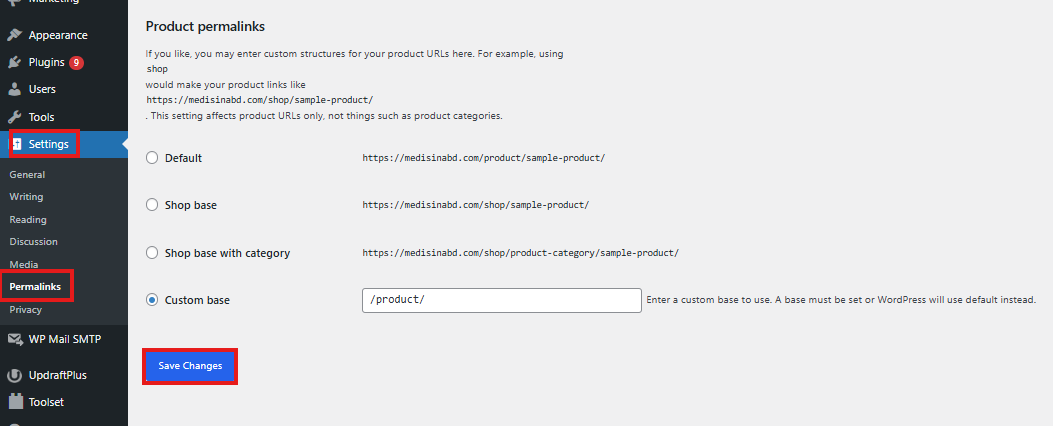
This refreshes WordPress rewrite rules.
Filter pages show duplicate SEO titles
Review your SEO title template and make sure it includes useful filter-specific text.
Also check if another SEO plugin is overriding the title.
Compatibility with SEO Plugins
Dynamic AJAX Product Filters for WooCommerce can work alongside SEO plugins, but some SEO plugins may override titles, descriptions, canonical URLs, or indexing rules.
If your SEO title or description is not showing correctly, check settings in your SEO plugin.
Common areas to check:
Meta title templates
Meta description templates
Canonical URL settings
Index/noindex settings
Archive page SEO settings
WooCommerce product archive SEO settings
Important Notes
SEO filtering should be used carefully.
Not every filtered URL should be indexed. Too many indexed filter combinations can create duplicate or low-value pages.
Focus on important filter pages that customers search for and that have useful product results.
Examples of valuable SEO filter pages:
Brand + category pages
Color + category pages
Sale category pages
In-stock category pages
Popular size/category pages
Important price range pages
Examples that may not need indexing:
Very specific multi-filter combinations
Empty result pages
Low-value internal filter combinations
Temporary filter pages
Duplicate filter combinations
Summary
The SEO settings in Dynamic AJAX Product Filters for WooCommerce help create more search-friendly filtered product pages.
Use these settings to manage:
Enable SEO
Indexable filter links
SEO title
SEO description
SEO keywords
SEO permalink structure
Attribute type in permalinks
Filters word in permalinks
Permalink prefixes
For best results, use URL-based filtering, write clear SEO titles and descriptions, keep permalink prefixes meaningful, and only index filtered pages that provide real value to customers and search engines.